What Commercial Kitchen Hood Service and Maintenance Covers
Commercial kitchen hood service and maintenance covers the hood, its filters, the exhaust fan, the make-up air unit, the controls and the fire suppression system, each on its own schedule. Duct cleaning is part of the picture too, but it is a specialized trade with its own frequency rules, so this page treats it briefly and points to our kitchen exhaust cleaning and inspection guide for the details.
Most hood problems build slowly. Filters load a little more each day, a belt stretches, a bearing starts to run warm, and airflow drops until the hood starts to spill smoke on a busy Friday. Routine maintenance catches these changes while they are still cheap to fix.
| Component | Typical task | Who usually does it |
|---|---|---|
| Grease filters | Remove, wash, inspect, reinstall | Kitchen staff |
| Hood interior and lights | Wipe down, check lamps and lenses | Kitchen staff |
| Exhaust fan | Belts, bearings, wheel, hinge, containment | Service technician |
| Make-up air unit | Filters, belts, burner and controls | Service technician |
| Airflow | Measure exhaust and supply, check capture | Service technician or balancer |
| Fire suppression | Semiannual inspection and service | Licensed suppression company |
| Grease duct and fan interior | Inspection and cleaning | Exhaust cleaning contractor |
Grease Filter Cleaning and Replacement
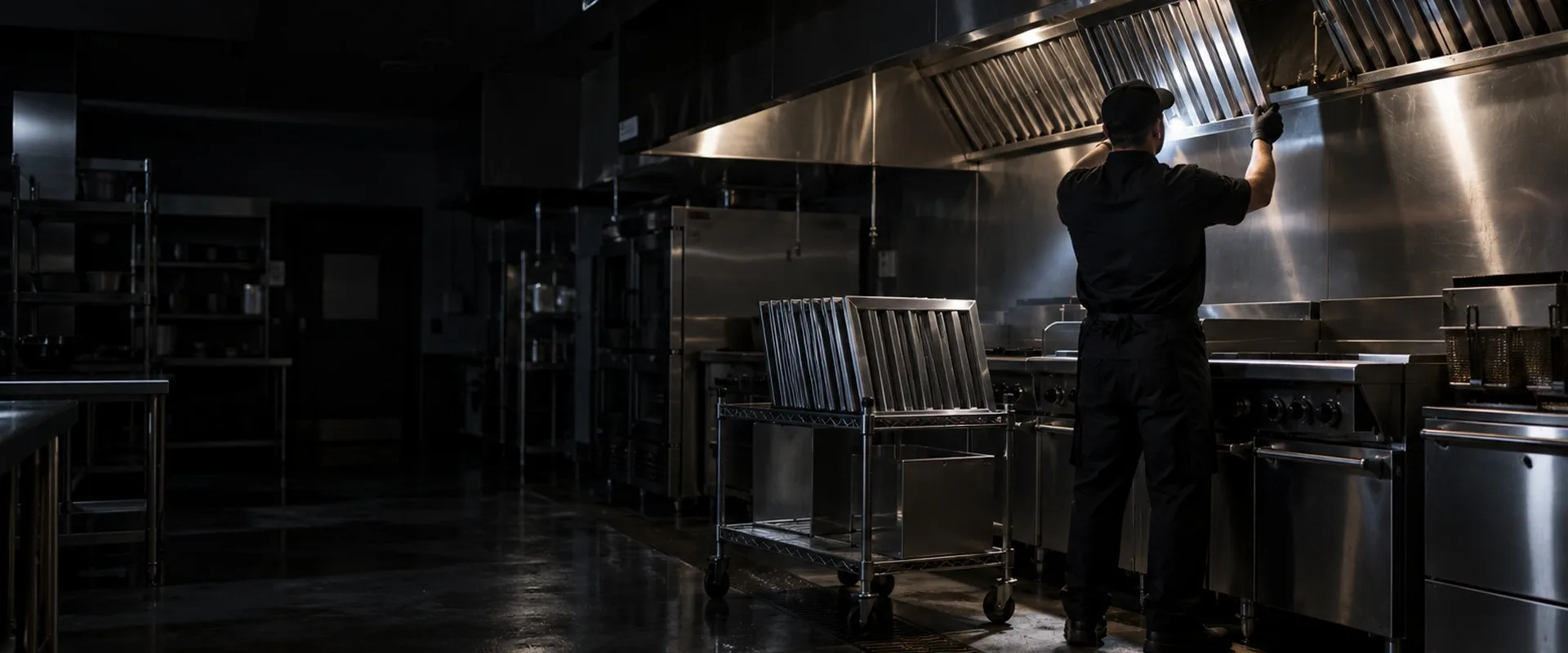
Grease filters are the first line of defense and the item that needs attention most often. On a busy fryer or charbroiler line, filters are often cleaned daily; lighter lines may go a week. The right interval is whatever keeps the filters from visibly loading between cleanings.
- Wash baffle filters in hot water with a degreaser, by hand or in a dishwasher if the manufacturer allows it.
- Let filters dry and reinstall them in the same orientation, with baffles running the direction the hood is designed for.
- Never run the hood with a filter missing. A gap lets grease straight into the plenum and duct.
- Replace filters that are bent, cracked or no longer seat tightly. Replacements must be listed grease filters of the correct size.
- Do not substitute mesh filters for baffle filters in a Type I hood unless the hood listing permits it.
Filter day is also a good time to check the hood lights. Replace failed lamps with the type the fixture is listed for, and make sure the glass lenses or globes are intact and seated, since an open fixture inside a Type I hood collects grease. On hoods with demand control ventilation, wipe temperature probes and optical sensor windows clean so the controls read cooking activity correctly.
While the filters are out, look into the plenum. Heavy grease behind the filters means they are being cleaned too rarely or are not fitting properly.
Exhaust Fan Belts, Bearings and Hinge
The roof exhaust fan does the hardest work in the system and is the part most often neglected, simply because no one sees it. A periodic fan inspection, commonly monthly or quarterly depending on use, should cover:
- Belts. Check tension and wear on belt-drive fans. A slipping belt cuts airflow without any obvious symptom inside the kitchen.
- Bearings. Listen for noise, feel for heat and play, and grease them if the bearings are the regreasable type, following the manufacturer's schedule.
- Wheel. Look for grease buildup on the blades, which throws the wheel out of balance and reduces airflow.
- Hinge. Confirm the hinge kit works and the fan can tilt open for cleaning; a fan without a working hinge often gets its duct cleaned poorly.
- Electrical. Check the disconnect, wiring and motor amperage against the nameplate.
Direct-drive fans have no belts but still need bearing and wheel checks. More on fan types is on our commercial kitchen exhaust fan page.
Rooftop Grease Containment
Grease that leaves the fan discharge has to be caught before it reaches the roof membrane. Most upblast fans have a grease drain spout feeding a containment box or absorbent filter system.
Containment fills up, and when it does grease runs onto the roof. That damages many roofing materials, creates a slip hazard and becomes fuel near the fan. Check the containment at every fan service and change the absorbent media when it is saturated. A dark stain spreading from the fan curb is a sign the interval is too long, or the duct and fan need cleaning.
Make-up air unit on the same visit
The make-up air unit usually sits a few yards from the exhaust fan, so it makes sense to service both on one roof trip. Replace or clean the outdoor air filters, which can clog quickly with cottonwood, leaves or dust in some seasons. Check the belt and bearings the same way as on the exhaust fan, confirm the intake damper opens fully, and on gas-fired units have a qualified technician check the burner, flame safeguard and discharge temperature control before the heating season. A starved make-up air unit leaves the kitchen too negative, which shows up inside as hard-to-open doors and hoods that spill.
Airflow Verification and Capture Checks
A hood can look clean and still be underperforming, so periodic airflow verification is worth doing. A technician measures exhaust and make-up air and compares them to the design values from the original balance report.
Common reasons airflow drops over time:
- Loaded filters or grease buildup on the fan wheel.
- Slipping or worn belts.
- Clogged outdoor air filters on the make-up air unit, which starve the supply and leave the kitchen too negative.
- Changes to the cooking line, such as a new charbroiler, that the hood was never designed for.
- Controls or drive settings altered to cut noise or energy.
A visual capture check with appliances running is the simplest test of all. Smoke or steam should rise into the hood and stay there. If it rolls out at the front edge or the ends, measure before changing anything.
Fire Suppression System Semiannual Inspection
The hood fire suppression system must be inspected and serviced at least every six months by a qualified, licensed fire suppression company. This is separate from hood maintenance and cannot be done by kitchen staff or a general service technician.
During the semiannual service, the suppression company typically checks the agent cylinder and pressure, nozzle positions and caps, detection line and fusible links (often replaced on a set schedule per the manufacturer and the standard), the manual pull station, and the fuel and power shutdown functions. The technician tags the system with the date of service.
Hood work and suppression work interact. If filters are changed to a different type, an appliance is moved or a new one is added under the hood, the suppression company needs to review nozzle coverage. Moving a fryer six feet can leave it unprotected.
Keeping a Hood Maintenance Logbook
A maintenance log is the proof that the work was done, and fire inspectors, health inspectors and insurers can ask for it. Keep it at the restaurant, organized by date, and include:
- Filter cleaning dates and who did it.
- Fan and make-up air service reports, with belts, bearings and filters noted.
- Airflow measurements whenever they are taken.
- Suppression system inspection reports and tags.
- Exhaust cleaning reports, including any areas the cleaner could not reach.
- Repairs, equipment changes and any changes to the cooking line.
Pay attention to notes from the exhaust cleaner about inaccessible sections. Those usually point to missing access doors that should be added.
Scheduling Hood Service Around Cooking Volume
The right maintenance schedule depends on what you cook and how much. A 24-hour diner with charbroilers loads filters, fans and ducts far faster than a school kitchen that steams and bakes. NFPA 96 ties exhaust system inspection frequency to cooking volume, and the same logic applies to the rest of the hood system.
If you are setting up a schedule for a new kitchen, start conservatively, inspect often for the first few months, and stretch intervals only when inspections show little buildup. For a new system, the startup balance report from commercial kitchen hood installation gives the baseline numbers. To discuss service for an existing hood, contact us with photos of the hood label and roof fan.
Hood Maintenance Questions
- How often should hood filters be cleaned?
- It depends on cooking volume. Filters over fryers, griddles and charbroilers in a busy kitchen are often cleaned daily, while lighter lines may go up to a week. A good rule is to clean them before grease visibly builds up, and to look into the plenum for grease that would indicate the interval is too long.
- Who is allowed to service the hood fire suppression system?
- Only a qualified, licensed fire suppression company should inspect and service the wet chemical system. It is commonly required at least every six months. Kitchen staff and general HVAC technicians should not adjust nozzles, links or cylinders, though they should report damage or changes to the cooking line.
- Why is grease leaking onto my roof around the exhaust fan?
- The grease containment at the fan is likely full or missing, or the duct and fan are carrying more grease than normal because filters or cleaning are overdue. Replace the absorbent media, check the fan drain, and review the filter and duct cleaning schedule. Roof grease is both a fire risk and damaging to the membrane.
- How do I know if my hood is losing airflow?
- The first sign is usually smoke rolling out of the hood front or ends while cooking, or a kitchen that feels hotter and smokier than before. Slipping belts, loaded filters and a dirty fan wheel are common causes. A technician can measure the airflow and compare it with the original balance report.
- Is duct cleaning part of hood maintenance?
- Yes, but it is usually done by a specialized exhaust cleaning contractor on a frequency based on cooking volume, as described in NFPA 96. Hood maintenance and duct cleaning should be coordinated so the fan hinge, access doors and containment are in good condition when the cleaners arrive.
- What records should I keep for my kitchen hood?
- Keep a dated log of filter cleaning, fan and make-up air service, airflow measurements, suppression inspection reports and exhaust cleaning reports. Also note any equipment changes on the cooking line. Inspectors and insurers may ask for these records, and they help technicians diagnose problems faster.